The Holywell Music Room, which opened in Holywell Street, Oxford in 1748, is usually described as Europe's first custom-built concert hall. That's some accolade in a continent that produced Bach, Handel, Mozart etc. There's an unproven tradition that Handel himself played here — it certainly hosted his music — and the venue is also said to have led to Haydn becoming popular. So is the claim true? A lot rests on the phrase "custom-built" or "purpose-built". Of course there were many venues throughout Europe hosting musical performances, how could there not be. But these venues had other uses as well. Oxford's own Sheldonian Theatre, much larger than the Holywell Music Room and situated only a few hundred yards away, had opened in 1669 and hosted many concerts. Handel definitely did play there in 1733. But as the Sheldonian was built to host the public ceremonies of the University of Oxford, not just music events, it cannot be described as a custom-bu...
Familiar, but not mundane They are among our most familiar items of street furniture; indeed there are more than 115,000 throughout the UK. Yet how many of us walk past a post box without considering how long it might have been there? Letter boxes have been a feature of our streets since the 1850s, when demand for postal services grew following the introduction of the Penny Post in 1840. The novelist Anthony Trollope is remembered as the Post Office official responsible for recommending the introduction of pillar boxes to allow for easier posting of private letters. These were first installed on the Channel Islands in 1852, and were introduced to the mainland the following year. Wall boxes started to appear a few years later. Early boxes were green, but red had become the standard colour by 1879. Scroll down for a selection of boxes, of both the pillar and wall variety, from the Victorian era, all bearing the VR (Victoria Regina) cipher. One of this selection is green, though not b...
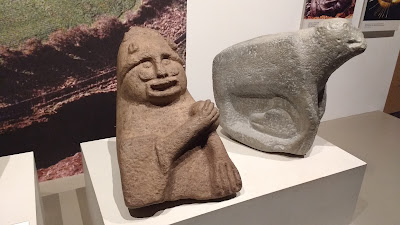
My first encounter with the Tandragee stone idol was with a replica in the Ulster Museum in Belfast. Replica in Ulster Museum (author's photo, all rights reserved) This curious little figure probably caught my eye because of its name, Tandragee being the village best known as the Northern Irish home of Tayto potato crisps. Peering at the figure a little more closely it seemed to be clutching its left arm (so I thought) with what looked like a smile, sitting beside another stone figure of a bear-like animal. I was astonished to discover that the original Tandragee idol wasn’t in another museum but had a much more unlikely home. Beneath a plaque commemorating a late 19th century archbishop of Ireland, worshippers and visitors to St Patrick’s Church of Ireland Cathedral in Armagh can see the Tandragee idol in all its glory sitting on a low stone plinth in a side aisle. The cathedral houses other pre-Christian idols in its crypt (judging by photos on Flickr, these have also been on dis...



Comments
Post a Comment